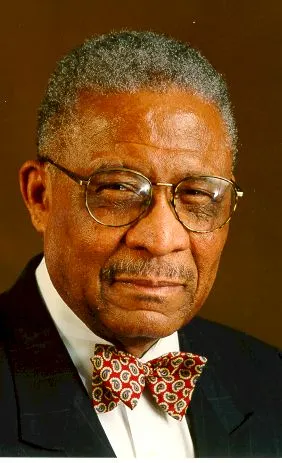
ABAA sends its heartiest congratulations to our member Ambassador Horace G. Dawson, who is enjoying his 100th year of a very fruitful life!
Horace G. Dawson, Jr. is a military veteran, scholar, educator, diplomat, Ambassador, and institution builder whose life and career embody the power of intellect, service, and principled leadership. From the segregated South to the highest levels of American diplomacy, Dawson’s story is one of preparation meeting purpose, as he has spent a lifetime building bridges between nations while also opening doors for future generations.
Born in Augusta, Georgia, in January 1926, Dawson came of age during a period when Black people in America faced significant barriers to education and public service. Yet he pursued learning with passion and determination, attending Lincoln University, one of the nation’s most historic HBCUs. His studies were interrupted when he was drafted into the U.S. Army, where he would serve in both Europe and the Philippines before returning to complete his degree. He later earned a master’s degree from Columbia University and a Ph.D. in mass communications from the University of Iowa, laying the intellectual foundation for a career spanning education, diplomacy, and public affairs.
Dawson began his career in education. He taught English at Southern University in Louisiana and later at North Carolina Central University, where he also served as director of public relations. His doctoral research examined how international students formed perceptions of the United States through media. That research attracted the attention of legendary journalist and U.S. Information Agency (USIA) Director Edward R. Murrow. In one of the most consequential moments of Dawson’s life, Murrow personally visited him to encourage him to join USIA. Dawson initially expected to stay only a year. Instead, he embarked on a diplomatic career that would last nearly three decades.
Dawson entered government service at USIA during the wave of African independence movements that transformed the continent in the 1960s. Assigned to Uganda just after independence, he found a nation eager to define its future and a university community wrestling with questions about America’s place in the world. Rather than relying on official pronouncements, Dawson focused on relationships. He strengthened the library at Uganda’s premier institution of higher education, Makerere University, organized public forums and cultural exchanges, and created two publications, Press Time USA and Uganda Calling, to connect Ugandans with a more accurate understanding of American life and to keep Ugandan students in the United States connected with developments at home.
Dawson’s success in Uganda led to increasingly influential USIA assignments in Nigeria and Liberia. In Nigeria, he helped found what became the School of Mass Communications at the University of Lagos, shaping media education in one of Africa’s most important nations. He also established the nationwide John F. Kennedy Memorial Essay Contest, an initiative that inspired thousands of young Nigerians and continued long after his departure. In Liberia, he advanced cultural diplomacy and promoted democratic institutions in a country whose political system had been modeled on that of the United States. Throughout these assignments, Dawson consistently demonstrated that diplomacy was most effective when grounded in education, dialogue, and respect.
By the early 1970s, Dawson had risen to become Director of African Affairs for USIA, overseeing American information and cultural programs across the continent. During the Cold War, he confronted challenges ranging from Soviet influence to the struggle against apartheid. One initiative he championed was establishing a U.S. information reading room in Soweto, South Africa, giving a community systematically denied opportunities under apartheid access to books, information, and educational resources. He understood that ideas could be as powerful as policy in advancing freedom and democratic change.
President Jimmy Carter noticed Dawson’s leadership and diplomatic skill and, in 1979, appointed him U.S. Ambassador to Botswana, making him one of the most senior Black diplomats of his generation. Botswana, a stable democracy bordering apartheid South Africa, offered Dawson an opportunity to combine diplomacy with principle. There, he promoted expanded educational cooperation, encouraged economic development, helped negotiate major communications installations, and advocated for stronger attention to the concerns of southern Africa’s frontline states. Even when official policy embraced “constructive engagement” with South Africa, Dawson remained clear-eyed about the moral challenge posed by apartheid and the importance of democratic governance throughout the region.
After completing his tenure leading the U.S. Mission in Botswana, Ambassador Dawson returned to the United States in 1983, where he held his final few assignments, including working in the recruitment division of the State Department, serving as Special Assistant to the Director of the USIA, and also serving as Director of USIA’s Office of Equal Employment Opportunity until his retirement in 1989.
However, retirement from government service did not slow Ambassador Dawson down or diminish his impact. He joined the faculty of Howard University’s School of Communications and was appointed Director of its Patricia Roberts Harris Public Affairs Program. In 1993, perhaps among his most impressive and enduring legacies, Ambassador Dawson established the Ralph J. Bunche International Affairs Center at Howard University and, in 1997, became its director.
He established the Bunche Center as a central hub for Howard University’s global programs, to coordinate study abroad opportunities, and to connect the campus with international embassies, governments, and organizations. The Center has continued to grow and has become a hub of mentorship, engagement, and education for the next generation of globally minded leaders. Ambassador Dawson also helped lead the way in championing the recruitment of minorities into the Foreign Service, a commitment that continues to this day. In this regard, mentorship became one of his most enduring forms of leadership and diplomacy.
The legacy of Horace G. Dawson Jr. extends far beyond the embassies where he served. He helped shape how America engaged with newly independent nations, defended democratic values during some of the twentieth century’s most turbulent years, and dedicated himself to ensuring that future generations would have opportunities he never had. On January 30, 2026, Ambassador Dawson reached the milestone of 100 years of age. As America commemorates 250 years of history, Dawson stands as a powerful reminder that Black leadership has not only transformed the nation at home but has also helped define its voice and values around the world, and that we should all aspire to mentor and build bridges for the next generation of leaders.
One Response
I fondly remember Amb. Dawson when I started my diplomatic career as one of the first Charles B. Rangel Fellows. He was so supportive. Would love to get in touch and send him a note to express my gratitude for helping to jump start my career in foreign affairs.